
4,000 PSI Hydro-Jetting & Sewer Descaling
For a mainline that keeps backing up, hydro-jetting is the fix that addresses the whole pipe, not just the blockage in front of the cable. A multi-directional nozzle scours grease, mineral scale and tree roots from the full inner circumference, and a post-cleaning CCTV pass proves the diameter is restored before the technician leaves.
Call (607) 564-1499 — Talk to Dispatch
You get an itemized, written flat-rate quote before work starts. No surprise hourly billing.
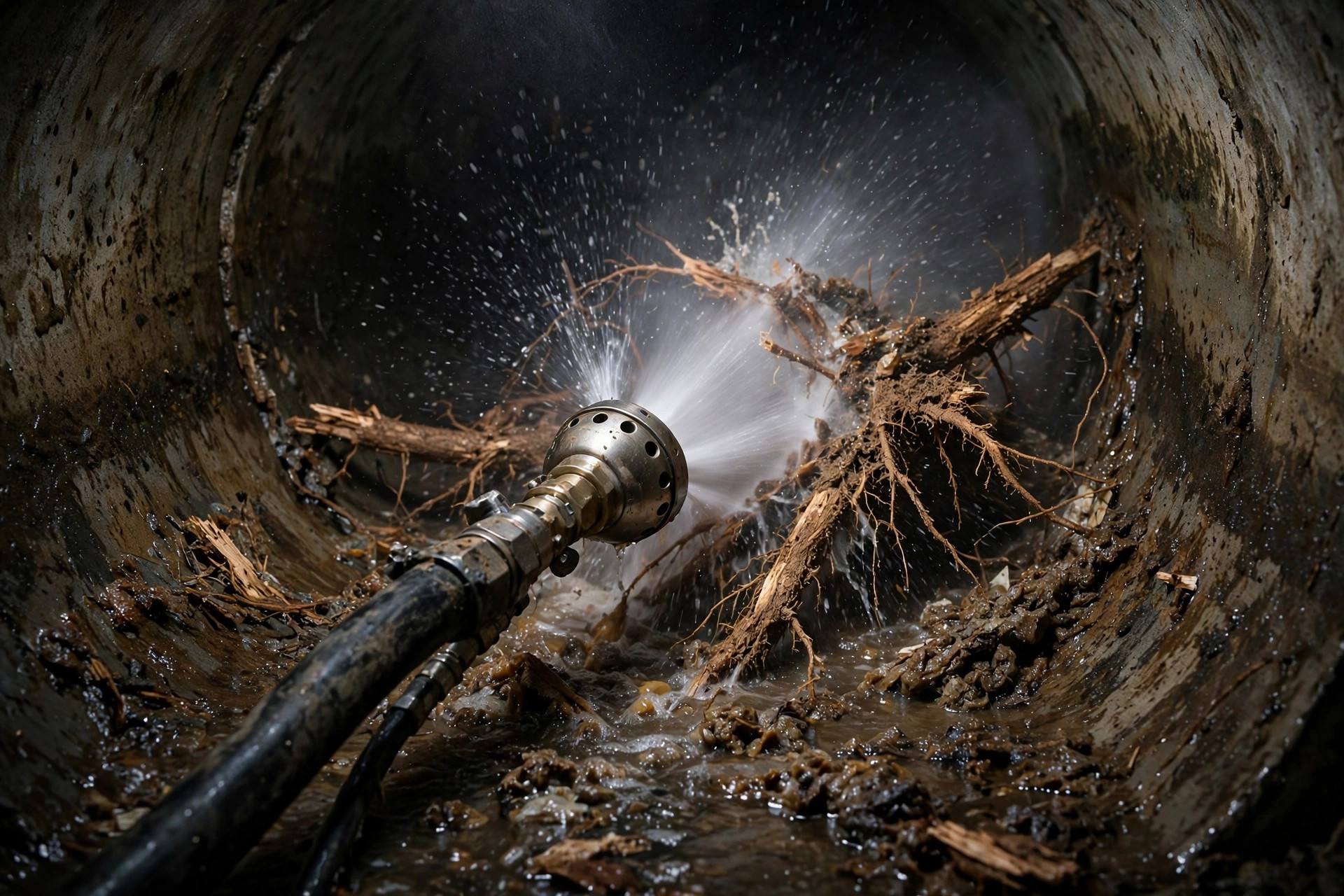
Representative preview image. It is not labelled as a real work photo; real job photos will replace representative images when supplied.
How hydro-jetting works, step by step
- Locate the cleanout and confirm which fixtures are affected, so the jetting run covers the right section.
- Run a CCTV camera first and record the pipe material, joints, offsets and root entry points.
- Choose the nozzle for the job: a rotary root-cutting nozzle for roots, a descaling head for scale, a flushing nozzle for grease and sludge.
- Jet in controlled passes at up to 4,000 PSI and 18 GPM, working from downstream back toward the cleanout.
- Run the camera again and show the before-and-after condition, then leave the written quote and warranty on file.
What the technician checks first
- Pipe material and age — clay laterals crack at hub joints, cast iron scales and narrows, PVC and ABS behave differently under pressure.
- Whether roots entered at one joint or along a run, which decides nozzle choice and pass count.
- Whether the line has a belly, offset or collapse that jetting cannot fix and that needs a repair plan instead.
- Downstream access, so flushed debris leaves the system instead of settling in the next section.
Pipe materials, and why they matter
Cast iron needs descaling care because scale narrows the bore over decades. Clay needs joint-by-joint attention because roots exploit hub joints. PVC and ABS are smoother and usually hold diameter, but a bad joint or a crushed section still needs camera proof, not assumption. Jetting pressure is calibrated to the material found on camera, not set to maximum by default.
When jetting is not the answer
If CCTV shows a collapsed section, a major offset, or a separated joint, jetting will clear debris but will not restore structure. In that case the honest next step is a repair scope for that section, with camera evidence, rather than repeated jetting visits.
Questions customers ask about this service
How is this different from snaking?
Snaking opens a channel through a clog. Jetting cleans the pipe wall itself, which is why it lasts longer on grease and root problems that snaking only relieves for a few weeks.
Will jetting clear tree roots completely?
A rotary nozzle cuts roots flush with the wall and restores diameter, and the post-cleaning camera shows it. Roots can return through a cracked joint over time, so a recurring root problem also needs a plan for that joint.
Is 4,000 PSI safe for my pipes?
It is safe when the pipe is inspected first and the nozzle and pressure are matched to the material. That inspection step is why CCTV comes before jetting on every mainline job.
Related services and areas
Emergency Plumbing
A related service from the same team.
Drain Cleaning & CCTV
A related service from the same team.
Water Heater Repair & Replacement
A related service from the same team.
Leak Detection
A related service from the same team.
Sump Pump Systems
A related service from the same team.
Ithaca
Hydro-jetting help in this area.
Lansing
Hydro-jetting help in this area.
Dryden
Hydro-jetting help in this area.
Cortland
Hydro-jetting help in this area.
Binghamton
Hydro-jetting help in this area.
Tompkins County
Hydro-jetting help in this area.